Helen marries Gilbert
The Tenant of Wildfell HallHelen marries Gilbert after Arthur Huntingdon’s death, bringing their long and interrupted relationship to a resolution that depends on her independent choice rather than on Gilbert’s hope alone. The marriage is delayed by Helen’s concern for her aunt and by her refusal to treat Arthur’s eventual death as a condition on which she and Gilbert should build a future; when the wedding comes, it is a deliberate commitment made on her terms.
Courtship and the Conditions of Marriage
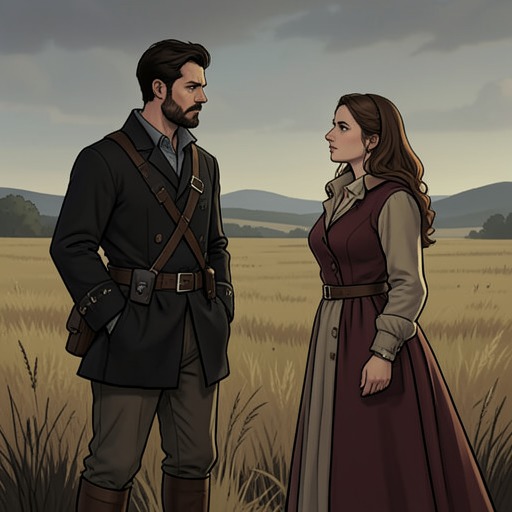
Gilbert’s proposal of a future together comes while Helen is still bound to Arthur. He says he will wait until Arthur has ended his career, but Helen will not accept that promise as a secure basis for their hopes. She objects both to the moral danger of wishing for another person’s death and to the practical impossibility of expecting Gilbert to suspend his life indefinitely: Arthur might live many years, leaving them in prolonged uncertainty. Her refusal makes clear that affection does not entitle Gilbert to regard her future as already promised to him.
The circumstances eventually change when Arthur dies. In the closing courtship, Gilbert is eager to turn their attachment into an immediate marriage, but Helen asks him to wait another year. She says that her aunt must first know him and have the opportunity to form her own judgment. Helen’s aunt might consider a rapid marriage rash because she does not yet know Gilbert; Helen therefore makes the introduction and cultivation of that relationship part of the path to marriage, rather than treating family approval as a formality to evade.
Helen’s Choice and the Timing
Helen’s decision to marry is explicitly hers. She argues that because the marriage is to please herself, she ought to consult her friends about its timing. Her insistence on another year is not a rejection of Gilbert: she proposes that they write every day and says that the interval will not be a separation, since she expects they will sometimes see one another. The delay gives her room to reconcile personal desire with consideration for her aunt, while making clear that she—not Gilbert’s impatience—determines when the marriage will take place.
Gilbert initially protests that he cannot endure so long apart, but Helen asks him to consider his fidelity. Her response turns the waiting period into a test of trust rather than a withdrawal of affection. She does not pretend that she herself wants the delay; instead, she holds to it because she believes she should consult those close to her before fixing the date. The two therefore reach the marriage through a negotiated interval, with daily correspondence sustaining their connection and Helen retaining authority over the decision.
Marriage and Its Place in the Ending
The couple are married in summer on an August morning. The account places this wedding after the death of Helen’s aunt, whose loss is described as a sorrow to the friends and dependents left behind, not to the aunt herself. The chronology marks the difference between the earlier courtship’s uncertainty and the eventual, settled marriage: the couple’s plans have had time to accommodate the family relationship Helen considered important.
Gilbert says that he and Helen have lived in great harmony and remain blessed in one another’s society, with their children growing up around them. This retrospective account presents the marriage not as a reward for Gilbert’s persistence alone, but as a lasting domestic partnership formed after Helen’s difficult first marriage and secured by mutual attachment. His earlier desire to wait for her is answered, finally, by a marriage Helen freely chooses and whose timing she has helped set.
Contrast with Helen’s First Marriage
The marriage’s significance is sharpened by the contrast with Helen’s relationship with Arthur. During that marriage, she asks to take their child and what remains of her fortune and leave; Arthur refuses both to let her go with the child and to let her leave without him. Helen consequently declares that they will henceforth be husband and wife in name only. That earlier separation establishes the material and personal limits within which she had tried to protect herself and her child.
Her eventual marriage to Gilbert follows a different pattern. Its conditions are not imposed by a husband refusing her departure: Helen states what she wants, resists a future based on Arthur’s death, and sets an interval before the wedding so her aunt can know Gilbert. The narrative thus closes not merely with a new marriage, but with a distinct form of marital choice—one in which Helen’s judgment and timing remain central.
Narrative Framing and Resolution
The marriage is told retrospectively by Gilbert in his account to Halford. The closing narrative moves from the lovers’ discussion of delay to the report of the summer wedding and then to the couple’s harmonious life together. Its compressed chronology makes the wedding a conclusion to a much longer history, while the reference to their grown children shows that the union continues beyond the courtship’s final negotiations.
The outcome also resolves the tension between Gilbert’s hope and Helen’s insistence on moral and practical limits. He had once proposed waiting through the uncertain lifetime of Arthur; Helen rejected that as an unwise foundation for their future. After Arthur’s death, she still does not surrender the decision to Gilbert’s urgency. Their eventual marriage follows only after she has chosen it, consulted her aunt, and agreed on its timing, and Gilbert’s account presents their subsequent life together as enduringly harmonious.